How Many Must Suffer?
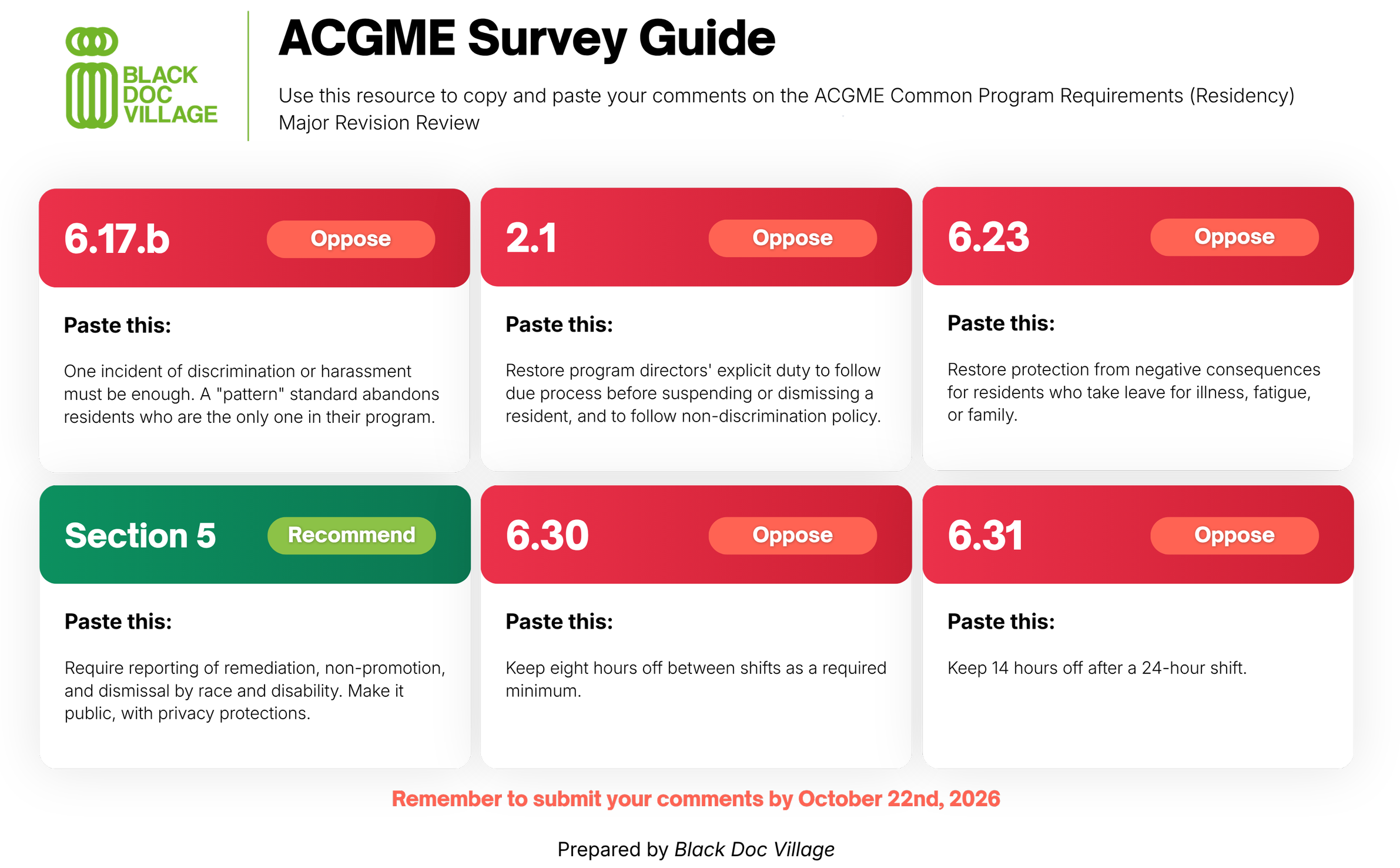
The Committee of Interns and Residents raised the alarm first. The ACGME, the body that accredits every residency program in the country, has proposed deleting the guidance that residents should have eight hours off between shifts.
That alone should worry everyone. I thought we had all agreed that adequate sleep was a necessity for every human being. It’s like the ACGME has decided that resident physicians are just mules, to be worked into the ground.
And that’s not even the worst thing in the proposal.
The ACGME calls this revision a 43 percent reduction in requirements. Its stated goal is reducing burden. Read the rationale closely and you will see whose burden counts. Post-call rest after a 24-hour shift drops from 14 hours to 12, "to reduce burden related to developing resident schedules." Limits on night float and call frequency disappear. Specialties that set stricter work-hour limits, like emergency medicine, are barred from keeping them. Asked how each change affects residents, the ACGME's answer is nearly always the same: "No impact anticipated."
The deeper changes are quieter. And they will not land on all residents equally.
One incident is no longer enough
Today, a residency program can be cited for a single occurrence of discrimination or harassment. Under the proposal, a program is out of compliance only if there is a "pattern," or if it failed to address the conduct adequately. The program judges its own response.
Black physicians remain a small share of residents. Many programs have one Black resident, or none. In a program with one, what does a "pattern" look like?
It means the same resident must be targeted again and again, and document every incident, while being evaluated by the people they are reporting. Or it means waiting for the next Black resident to arrive and suffer the same treatment. How many must suffer before any action?
A pattern standard does not measure harm. It measures how many times harm can be survived and recorded. For the only Black resident in a program, the first incident is the pattern.
Due process goes generic
It’s bad enough that there is no standard for due process: Programs get to write whatever they want and ACGME only takes punitive action if programs violate what they wrote. Now ACGME wants to weaken that. The current rules name a program director's duty to follow grievance and due process procedures "when action is taken to suspend or dismiss." They separately name the duty to comply with non-discrimination policies. The proposal folds both into one line: compliance with "Sponsoring Institution policies." The ACGME calls this reorganization and expects no impact.
Meanwhile, the program director's authority over "assessment and promotion of residents, disciplinary action" stays explicit. Power remains spelled out. The checks on that power become boilerplate.
Our research at Black Doc Village shows that discretion in remediation and dismissal is exactly where bias does its work. Black residents are disproportionately monitored, disciplined, and dismissed. Generic language gives a resident facing dismissal nothing specific to cite.
The protections that quietly disappear
The rule that absence policies must be applied "without fear of negative consequences" for residents who were sick, exhausted, or caring for family is absorbed into a policy that only says how leave is requested and covered.
"Suicidal ideation" and "potential for violence" are no longer named in the required text on resident mental health.
Required fatigue education is deleted as a "checkbox exercise."
Who is caring for those who care for us?
Physicians die by suicide at higher rates than the general public. Suicide is a leading cause of death among residents. Making residency harder for them is only going to make it worse. The people on the front line taking care of all of us should not be treated like they are expendable.
Only about one in four residents belongs to a union. The rest have their employer, their program director, and an accrediting body that now treats their protections as burden.
The ACGME's own rationale admits residents "can fall outside the protection of relevant laws, due to their status as both trainee and employee." That is true. It is the reason these protections matter. You cannot acknowledge a gap in the law and then widen it.
To be fair, some changes help residents: new protected time for lactation, a required policy for pregnant residents, and tighter limits on averaging work hours. Those deserve support. They do not offset what is being removed.
Comment now
The ACGME says it considers every comment before the board votes. Silence will be read as consent.
Click here to access the ACGME comment page and scroll to copy and paste our suggestions into the survey. The deadline for submitting your feedback is October 22nd.
Tell them three things:
Keep single-incident accountability for discrimination and harassment. One is enough.
Restore explicit due process and non-discrimination duties for program directors.
Restore protection from retaliation for residents who take needed leave.
Residents cannot afford for us to stay quiet. Neither can their patients.
Vanessa Grubbs, MD, MPH
Founder and President of Black Doc Village